
Prime minister's office wants OMCs to bear credit subsidy for remaining 8 subsidised units on reimbursement basis.

The falls meant that both crude futures were at their lowest levels since mid-April

Zomato emerged as the biggest gainer, followed by Reliance, Nestle, Asian Paints and Power Grid.
Reliance Industries Ltd, India's most valuable company, is back on a growth path after six months of challenges as it posted better than expected earnings in the December quarter, brokerages said.

The fast-moving consumer goods (FMCG) sector is likely to report muted results in the fourth quarter of 2024-25 (Q4FY25) due to weakness in urban consumption. The weakness may persist through the first half of 2025-26 (H1FY26).

RBI's interest rate decision, macroeconomic data, global trends and trading activity of foreign investors are the crucial factors to drive equity markets in a holiday-shortened week ahead, analysts said. Markets would remain closed on Monday for Gandhi Jayanti. "While global cues will continue to dictate trends in local markets, focus will shift to RBI's monetary policy announcement on Friday. "Although the market is expecting a status quo on interest rates, global concerns like rising US dollar index and bond yields coupled with surging crude oil prices continue to weigh on investors' minds.

The government on Thursday permitted 100 per cent foreign investment under the automatic route in oil and gas PSUs which have received in-principle approval for strategic divestment. The move would facilitate privatisation of India's second biggest oil refiner Bharat Petroleum Corp Ltd (BPCL). The government is privatising BPCL and selling its entire 52.98 per cent stake in the company.

The RBI interest rate decision, industrial production data for June and the ongoing quarterly earnings from corporates would largely drive the stock markets this week, analysts said. Other major factors such as global market trends, the movement of oil prices and the trading activity of foreign investors would also influence trading, they added. "The market will have an eye on the RBI Monetary Policy Committee (MPC) meeting, which will be announced on August 10, 2023. We are heading towards the last batch of Q2 earnings of key companies such as Adani Ports, Coal India, Hero MotoCorp, Hindalco and ONGC, among others, which will lead to stock-specific movement," said Pravesh Gour, senior technical analyst, Swastika Investmart Ltd.

Petrol and diesel prices were hiked by 60 paisa per litre on Monday, for the second day in a row, as State-owned oil firms reverted to daily price revisions after an 83-day hiatus. Petrol price in Delhi was hiked to Rs 72.46 per litre from Rs 71.86 on Sunday, while diesel rates were increased to Rs 70.59 a litre from Rs 69.99, according to a price notification of state oil marketing companies.

There has been a sharp recovery in the headline corporate earnings in the April-June 2023 quarter (Q1FY24), after a dismal showing by early bird companies. The combined net profit of the 983 listed companies that have declared their quarterly results, so far, was up 64.7 per cent year-on-year to record a high of Rs 2.68 trillion in the first quarter, but growth in earnings remained lopsided because most of the incremental gains came from a handful of companies. Moreover, the quarterly numbers showed a continued slowdown in revenue growth.

Fast-moving consumer goods (FMCG) companies are expected to witness pressure on volumes in the October-December quarter. However, price hikes will help push up revenues, said brokerages.For India's largest engineering firm, Larsen and Toubro (L&T), the analysts expect a 20 per cent growth in consolidated revenue, and an 8.1 per cent core business Ebitda margin, up 40 bps from a year ago.
India's top fuel retailers IOC, BPCL and HPCL together lost around $2.25 billion (Rs 19,000 crore) in revenue for keeping petrol and diesel prices on hold during elections in five states, including Uttar Pradesh, Moody's Investors Services said on Thursday. State fuel retailers did not revise petrol and diesel rates for a record 137 days despite prices of crude oil (raw material for producing fuel) rising to $120 per barrel compared to around $82 in early November when the hiatus began. "Based on current market prices, the oil marketing companies are currently incurring a revenue loss of around $25 (over Rs 1,900) per barrel and $24 per barrel on sale of petrol and diesel, respectively," Moody's said in a report.
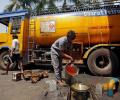
Investors shunned shares of oil marketing companies (OMCs) on Friday as they feared that the government's decision to cut retail prices of petrol and diesel could hurt the companies' profit margins in the near term. On Thursday, the government announced that OMCs will reduce pump prices of petrol and diesel after a record 22 months, making them cheaper by Rs 2 per litre in the national capital. The changes were effective from Friday.

Seafood is one of India's largest agricultural exports after basmati rice and buffalo meat.

Top government officials in New Delhi have started discussions with stakeholders ranging from shipping and container companies to export promotion councils to understand the impact of the Iran-Israel tensions and plan ahead. Inter-ministerial talks are also being lined up amid the crisis situation in West Asia, sources confirmed. While the crude flows are not directly under any threat, elevated oil prices remain a concern, according to officials.

The US Trade Representative noted that India's average applied tariff rate stood at 17% per cent, the highest of any major world economy.

'Expect India to keep doing well irrespective of geopolitics.'

Private carriers Jet Airways and Kingfisher owed over Rs 1,050 crore (Rs 10.50 billion) to the public sector oil marketing companies (OMCs) like Indian Oil, HPCL and BPCL towards the payment of jet-fuel bills as on November 15.
Oil prices jumped nearly $3 a barrel and gold and safe-haven bonds rallied on Friday after the killing of top Iranian commander Qassem Soleimani in an airstrike by the US in Baghdad.

The country's oil marketing companies are preparing for another round of increase in the price of aviation turbine fuel on July 1 as the average price of the fuel in international markets has shot up to around $160 per barrel in June from $150 per barrel in May.
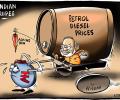
The Union government has collected Rs 94,181 crore through levy of excise duty on petrol and diesel in the first three months of the current fiscal on the back of a record tax on fuel that yielded 88 per cent higher revenue the previous financial year, the Lok Sabha was informed on Monday. Excise duty on petrol was hiked from Rs 19.98 per litre to Rs 32.9 last year to recoup gain arising from international oil prices plunging to multi-year low as pandemic gulped demand. The same on diesel was raised to Rs 31.8 from Rs 15.83 a litre, according to a written reply by Minister of State for Petroleum and Natural Gas Rameswar Teli in the Lok Sabha. This led to excise collections on petrol and diesel jumping to Rs 3.35 lakh crore in 2020-21 (April 2020 to March 2021), from Rs 1.78 lakh crore a year back, he said.

From the 30-share pack, Hindustan Unilever, Tata Motors, Axis Bank, Nestle India, Asian Paints, ITC, Reliance Industries, Mahindra & Mahindra, IndusInd Bank and State Bank of India were among the laggards. Larsen & Toubro, Tata Steel, JSW Steel, HDFC Bank, Adani Ports, Kotak Mahindra Bank, Bharti Airtel and PowerGrid were among the gainers.

Investors' wealth eroded by Rs 6 lakh crore in a single day on Wednesday as the BSE benchmark Sensex tumbled over 790 points. The 30-share BSE Sensex fell by 790.34 points or 1.08 per cent to settle at 72,304.88. During the day, it slumped 872.93 points or 1.19 per cent to 72,222.29.

'Even if India is attractive, FPIs currently lack the funds to invest, as money is being redirected to the US.'

Leading FMCG companies reported a decline in margins in the September quarter on account of higher input costs and food inflation, which ultimately slowed down the pace of urban consumption. Rising prices of commodity inputs such as palm oil, coffee and cocoa were also accentuated and some FMCG firms have hinted at a price hike. HUL, Godrej Consumer Products Ltd (GCPL), Marico, ITC, and Tata Consumer Products Ltd (TCPL) have expressed concerns over squeezing urban consumption, which according to industry experts forms 65-68 per cent of FMCG total sales.
Among Sensex shares, Tech Mahindra fell by over 6 per cent after the company reported a 60 per cent decline in net profit to Rs 510.4 crore in the December quarter. Bharti Airtel, ITC, HCL Technologies, Asian Paints, Wipro, HDFC Bank, Nestle, Tata Steel, Tata Consultancy Services and Maruti were among the other major laggards. NTPC, ICICI Bank, IndusInd Bank, Reliance Industries, JSW Steel, Bajaj Finance, Bajaj Finserv and Mahindra & Mahindra were among the gainers.

Benchmark stock indices Sensex and Nifty fell for the third day running on Friday due to weak trends in global markets and soaring crude oil prices. Foreign fund outflows also weighed on investor sentiments amid strengthening US bond yields which are nearing 5 per cent for the first time since 2007. The 30-share BSE Sensex fell 231.62 points or 0.35 per cent to settle at 65,397.62.
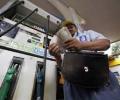
Under-recovery or the gap between retail selling price and the cost of import, this month dipped to an all-time low of 8 paise a litre, helped by the monthly increases and softening in international oil rates.
An increase in project cost will lead to corresponding increase in borrowing needs of these companies, particularly the oil marketing firms that have already borrowed nearly 50 per cent more this year compared to last year because of rising crude oil prices. Companies now fear this would make borrowing tougher in terms of higher interest rate and per client exposure norms of commercial banks.

Operating margins have been the primary driver of corporate earnings in India in recent quarters, despite revenue growth suffering from weak consumer demand. Companies across sectors have reported a sharp improvement in earnings before interest, tax, depreciation, and amortisation (Ebitda) margins over the past two years, benefiting from lower commodity and energy prices. Higher margins more than compensated for slower revenue growth, resulting in double-digit growth in net profit for five consecutive quarters.

Investors became richer by nearly Rs 8 lakh crore on Wednesday as benchmark BSE Sensex surged by 740 points amid value buying in utilities and power shares and a strong trend in global markets. The 30-share BSE Sensex surged by 740.30 points or 1.01 per cent to close at 73,730.23.

Reliance Industries Ltd on Thursday reported a 7.4 per cent rise in its December quarter net profit, as its retail business rebounded and telecom earnings rose. Its consolidated net profit of Rs 18,540 crore, or Rs 13.70 per share, in October-December - the third quarter of April 2024 to March 2025 fiscal (FY25) - compared to Rs 17,265 crore, or Rs 12.76 a share, in the same period a year back, according to a stock exchange filing by the company.
Oil-to-telecom conglomerate Reliance Industries Ltd (RIL) has surprised the street with a better than expected performance in its oil-to-chemicals (O2C) division in October-December 2024 (Q3FY25). RIL executives attributed it to favourable feedstock sourcing and higher volumes. However, they also listed cost optimisation and other measures.

The impact of Trump's announcement of increasing import tariffs will have negligible benefit for India not because of companies trying to shift from China to other countries or their supply chains being affected due to their Chinese operations but because of our faulty policies, explains Mudit Jain.
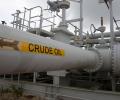
Indian imports of Russian oil plunged by a record in August month-on-month (M-o-M) as discounts on the fuel shrank in tandem with rising Brent oil prices. Higher crude prices will drive inflation or hurt earnings at oil companies and India's fiscal position if such spikes are not passed on to consumers. Indian purchases of Russian crude declined by around 24 per cent in August from July to the lowest level since January, with refiners expecting volumes to drop further amid rising rates of Russian benchmark Urals grade, substantial stocks at refiners, and planned maintenance at Indian refineries, according to ship tracking data and industry officials.

'The impact of COVID-19 on the economy has been so overwhelming that even a significant drop in global oil prices, which in normal times would have brought cheer, has posed new challenges for the government,' observes A K Bhattacharya.

The BSE benchmark Sensex surged about 241 points to end at 35,165.48 and the NSE Nifty gained 84 points to close at 10,688.65.

India maintains "high" import duties on a wide range of American goods such as agricultural items, drug formulations, and alcoholic beverages, besides imposing non-tariif barriers, a US report has said. A day before announcing reciprocal tariffs, the US Trade Representative (USTR) released the 2025 National Trade Estimate (NTE) Report on March 31.
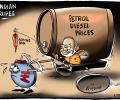
On Tuesday, Petroleum Minister Dharmendra Pradhan met Russian oil giant Rosneft's chief executive officer Igor Sechin and discussed raising crude imports from that country, in addition to talks about going for more acquisitions.
